Restaurant Water Bill Reduction Starts With the Bill
Kitchen water, sewer pass-through, meter behavior, and local rates decide the savings case. Smart Valve belongs in that broader cost-reduction plan.
Restaurants should evaluate water savings by separating kitchen usage, restrooms, sewer charges, meter size, and local rate structure before choosing a fix. Smart Valve is most relevant when a restaurant has high recurring water and sewer spend, indoor use that drives wastewater charges, and bill history that supports a metered-volume assessment.
Proven Results for Restaurants & Food Service
Common Water Cost Challenges in Restaurants & Food Service
High Water Volume Operations
Dishwashing, food prep, ice machines, and cleaning operations consume massive amounts of water, multiplying any meter inaccuracies.
Thin Profit Margins
Restaurant margins are razor-thin. Every dollar saved on utilities goes directly to your bottom line.
Frequent On/Off Cycles
Restaurant equipment constantly cycles on and off, causing pressure surges and meter over-spin.
Health Code Compliance
Water solutions must not compromise food safety or health department compliance requirements.
Equipment Wear
Pressure fluctuations accelerate wear on expensive commercial kitchen equipment like dishwashers and ice machines.
Sewer Cost Multiplier
Sewer charges are typically billed 1:1 with water usage, so meter inaccuracies cost you double.
Water-bill decision guide
How to evaluate water savings for Restaurants & Food Service
A restaurant water bill is rarely just a water-usage problem. The financial exposure often comes from indoor kitchen use flowing through to sewer charges, plus local rates, meter size, and recurring operating patterns.
Typical water-use drivers
- Dish machines, pre-rinse sprayers, pot sinks, and food-prep rinsing
- Ice machines, beverage stations, steam equipment, and filter backwash
- Restrooms, hand sinks, floor cleaning, and patio or landscape irrigation
- High-frequency start/stop demand during service peaks
Bill components to separate
- Metered water volume in gallons, kGal, CCF, or MCF
- Sewer or wastewater volume tied to indoor metered water
- Fixed meter charges based on service size
- Local surcharges, stormwater charges, taxes, and tier penalties
Common waste sources
- Leaking toilets, faucets, flush valves, and pre-rinse stations
- Oversized or poorly tuned pre-rinse spray valves
- Water-cooled ice machines or inefficient dish equipment
- Metered-volume exposure from line conditions and pressure volatility
Where Smart Valve fits
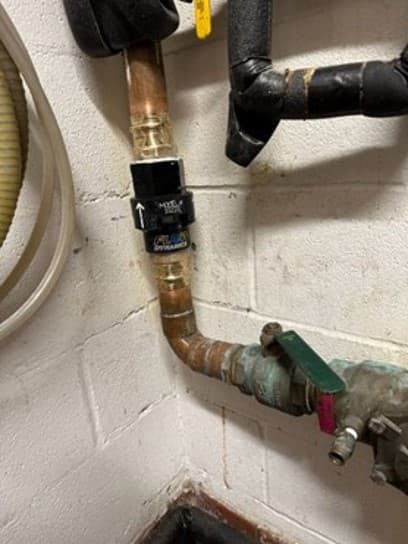
Smart Valve fits after the restaurant has reviewed leaks, equipment, rate class, and sewer logic. It is evaluated at the meter as a way to reduce billed volume without asking kitchen staff or guests to change behavior, especially when sewer charges follow water volume.
Documented food-service and adjacent food-production examples include Life & Brand South Africa at roughly 40% savings and Panna To Go Food MFG at 33.5% savings with a 6-month payback. Site-specific results still require bill review.
Estimate restaurant savings from your actual bill
Use your monthly water and sewer spend or usage to model a metered-volume reduction at local rates, then submit bills for a property-specific review.
What we need to evaluate your site
Smart Valve Benefits for Restaurants & Food Service
Our proven technology delivers measurable results for restaurants & food service across the country.
Cuts the Volume That Drives Sewer Exposure
For indoor-use restaurants, water reductions can matter twice: once on the water line and again where sewer is billed from metered water.
Supports a Bill-Based ROI Case
The savings model starts with actual water and sewer bills, not a generic restaurant benchmark.
Equipment Protection
Pressure stabilization protects expensive commercial kitchen equipment from surge damage, reducing maintenance costs.
Zero Operational Impact
The evaluation focuses on a main-line installation path, so the goal is to reduce billed volume without retraining kitchen operations.
Works Alongside Fixture and Leak Work
Smart Valve should complement pre-rinse, leak, dishwasher, and ice-machine improvements rather than replace them.
NSF Certified Safe
NSF 61 and NSF 372 certification ensures the valve is safe for potable water in food service environments.
Restaurants & Food Service Success Stories
Life & Brand Restaurant
Restaurant case-study record shows monthly cost moving from about $1,440 to $900 after installation, with savings subject to local rate and operating context.
Read Full Case Study →Panna To Go Food MFG
Adjacent food-production case study shows annualized gallons reduced from 3,171,068 to 2,107,579, useful proof for high-volume food-service evaluation.
Read Full Case Study →Frequently Asked Questions
Common questions about Smart Valve for restaurants & food service.
Why do restaurants see higher savings than other businesses?
Restaurants often have high indoor water use, frequent equipment cycles, and sewer charges tied to metered volume. That makes every verified reduction in billed volume more valuable.
Is the valve safe for food service water systems?
Absolutely. Smart Valve is NSF 61 and NSF 372 certified, ensuring it meets all safety standards for potable water in food service environments.
Will installation disrupt kitchen operations?
Installation planning depends on meter access, service line layout, and plumber availability. Restaurants should expect the assessment to identify the lowest-disruption installation window before scheduling.
How does Smart Valve protect my equipment?
The valve acts as a shock absorber, reducing pressure spikes by up to 63.98%. This protects expensive equipment like commercial dishwashers and ice machines from pressure-related wear.
What size valve do I need for my restaurant?
Valve size is matched to the service line and meter context. The assessment should confirm meter size, line size, flow requirements, and any local plumbing constraints.
Can I install Smart Valve in multiple restaurant locations?
Yes. Many restaurant groups have implemented Smart Valve across all their locations. We can coordinate multi-location installations.
Stop Paying For Air in Your Waterline
Get a free consultation to see how much you could save with the Smart Valve. Average return on investment in just 1.4 years.