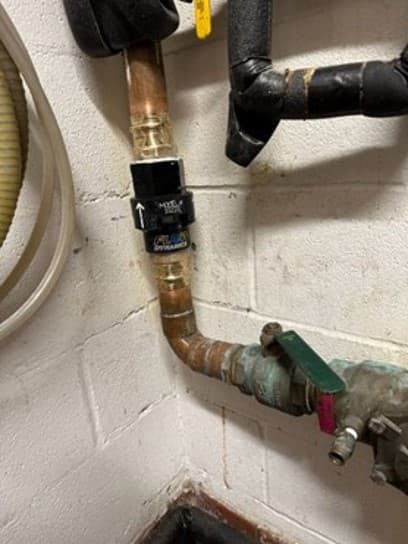
Built to Reduce Metered Air and Calm the Line
Smart Valve is installed in-line so air movement and pressure volatility are handled before they distort the way the system behaves at the meter and downstream.
Smart Valve works by conditioning the flow before it is measured, limiting the air component that can contribute to over-registration while helping the line behave more consistently under pressure changes. The result is a water system that bills more cleanly and operates with less volatility.
Why Water Meters Over-Register
Standard water meters measure what moves through the line. When air enters that line, the meter does not always have a practical way to ignore it. That is the root of the billing problem Smart Valve is built to address.
The other half of the problem is operational: the same conditions that introduce air into the system often bring unstable pressure behavior with them. That is why the valve’s effect is felt in both billing and system performance.
Common Air Sources
Routine maintenance and line repairs introduce air into municipal and on-site water systems.
Pressure changes and start-stop demand cycles create pockets that travel with the line flow.
Turbulence and dissolved-air release can cause meters to register more than true water volume.
What the Valve Changes
The value is not just one mechanism. The system is useful because it changes how the measured line behaves as a whole.
Billing Accuracy
By limiting the air component moving through the metered line, the Smart Valve reduces one of the core causes of inflated measured volume.
Pressure Stability
The same installation also helps calm pressure spikes and inconsistent line behavior that can show up as equipment stress or user complaints.
Testing Basis
Texas A&M Engineering Experiment Station findings are often referenced because they show how trapped air and unstable line conditions can materially distort what a meter records. Smart Valve is positioned as a practical in-line response to that operating reality.
Installation Flow
The installation path is intentionally short. The goal is to get the valve into the correct location with minimal disruption and a clean return to service.
Assess the line
The installation starts by confirming meter size, available pipe run, and the best location between the meter and downstream distribution.
Install the valve
The valve is tied into the existing line with a short water interruption while the assembly is set and connected.
Stabilize and verify
After the tie-in, the system is brought back online and checked for expected pressure behavior, fit, and operating stability.
Common Questions
These are the operational questions that usually come up before installation is approved.
Will the Smart Valve affect my water pressure?
No. The Smart Valve is designed to maintain usable water pressure while reducing spikes and instability that can travel through the system.
How long does installation take?
Most installations take one to two hours of active work, with water interruption usually limited to a short window during the tie-in.
How long does the Smart Valve last?
The Smart Valve is built for long service life with durable materials and no recurring maintenance program. Installed correctly, it is intended to remain in service for many years.
Is the Smart Valve certified for water safety?
Yes. Smart Valve models are certified to NSF 61 and NSF 372 standards for potable-water applications.
Stop Paying For Air in Your Waterline
Get a free consultation to see how much you could save with the Smart Valve. Average return on investment in just 1.4 years.