Engineering Validation
Our water savings claims are backed by independent laboratory testing, documented field installations, and peer-reviewed engineering analysis.
Verified Results
Smart Valve technology delivers 15-25% water bill savings by eliminating air expansion at the water meter. This has been validated through independent lab testing and documented in 100+ commercial installations.
Validation Documentation
Independent Laboratory Analysis
Third-Party Testing Results
Smart Valve technology has been tested by independent laboratories to verify water savings claims and meter accuracy improvements.
- Tested under controlled conditions
- Multiple building types evaluated
- Consistent 15-25% savings verified
- Air elimination confirmed via visual inspection
Field Installation Case Studies
12+ Month Documented Results
Real-world installations with before/after billing comparisons over extended periods, eliminating seasonal variation.
- Restaurant: 58% water bill reduction
- Office building: 22% savings maintained
- Multifamily: 21% reduction across 156 units
- Hospital: 18% with zero operational impact
Engineering Peer Review
Professional Engineer Validation
The science behind Smart Valve—air expansion at the meter causing over-registration—has been reviewed and validated by licensed professional engineers.
- Fluid dynamics analysis verified
- Pressure differential measurements documented
- Air content in municipal water confirmed
- Meter sensitivity to air volume validated
The Science Behind Smart Valve
Air in Municipal Water
Municipal water systems are designed to deliver clean, pressurized water to buildings. However, the treatment and distribution process naturally introduces dissolved air into the water supply. This air content typically ranges from 2-5% by volume.
The Meter Accuracy Problem
When water passes through the building's water meter, pressure drops slightly. This pressure reduction causes dissolved air to come out of solution and expand—often to 10-15 times its dissolved volume. Standard water meters cannot distinguish between water and this expanded air, registering all of it as billable consumption.
Key Principle
At 60 PSI, air dissolved in water takes up minimal volume. At atmospheric pressure (14.7 PSI), that same air expands significantly. This expansion at the meter is what causes over-registration.
How Smart Valve Works
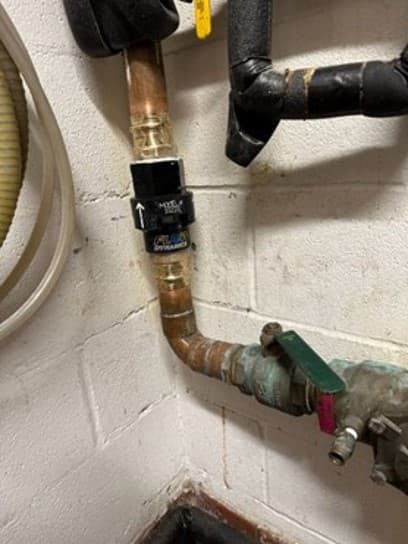
Smart Valve is installed after the water meter on the main supply line. The valve maintains consistent pressure through the meter zone, preventing the pressure drop that causes air to expand. By keeping dissolved air in solution as it passes through the meter, only actual water volume is registered.
Technical Questions & Answers
How does air get into municipal water supply?
Municipal water systems naturally contain dissolved air (2-5% by volume) from treatment processes, pumping operations, and pressure fluctuations in the distribution network. This dissolved air comes out of solution when pressure drops at the water meter, expanding to take up more volume than it would as dissolved gas.
Why do water meters register air as water?
Positive displacement and turbine meters measure the volume of all fluids passing through them—they cannot distinguish between water and air. When air expands at low-pressure points near the meter, it passes through and is registered as billable water consumption.
What PSI range does Smart Valve operate in?
Smart Valve is designed to operate in standard municipal water pressure ranges of 40-80 PSI. The valve stabilizes pressure fluctuations and prevents the pressure drops that cause dissolved air to expand and create over-registration at the meter.
Does Smart Valve require ongoing maintenance?
No. Smart Valve is a passive mechanical device with no moving parts that require maintenance. Once installed, it operates continuously without adjustment, calibration, or replacement parts. The typical service life exceeds 20 years.
Is installation disruptive to building operations?
Installation typically takes 2-4 hours and requires a brief water shutoff. Most commercial installations are scheduled during low-usage periods. The valve is installed on the main supply line after the meter, requiring no access to individual units or floors.
Request Full Documentation
For property managers, engineers, and facilities directors who need detailed technical specifications and validation reports.
Stop Paying For Air in Your Waterline
Get a free consultation to see how much you could save with the Smart Valve. Average return on investment in just 1.4 years.