PFAS "Forever Chemicals" Are About to Make Your Water Bill More Expensive: What Commercial Properties Need to Know
EPA's PFAS drinking water rule will cost utilities $1.5 billion/year in treatment upgrades — costs that will be passed directly to commercial ratepayers. Here's the timeline, the expected rate impact by city, and how to offset the increase before it hits.
The Bottom Line for Commercial Property Owners
The EPA's 2024 PFAS drinking water rule requires utilities nationwide to install advanced treatment systems (granular activated carbon, ion exchange, or reverse osmosis) to remove six "forever chemicals" from drinking water. The estimated compliance cost: $1.5 billion per year nationally, per EPA — with industry groups projecting even higher figures. These costs will be passed to ratepayers as water rate increases of 5-20%, starting as early as 2026-2027 and fully phased in by 2031. For commercial properties already facing rate hikes from aging infrastructure and drought surcharges, PFAS compliance is the third wave of cost pressure — and the one no amount of conservation behavior can avoid. The only defense is reducing your metered volume before the higher rates arrive.
What's Happening: EPA's PFAS Drinking Water Rule
In April 2024, the EPA finalized the first-ever legally enforceable national drinking water standards for six PFAS compounds — PFOA, PFOS, PFHxS, PFNA, GenX (HFPO-DA), and a hazard index for PFAS mixtures. The maximum contaminant levels (MCLs) are set at 4 parts per trillion for PFOA and PFOS — extraordinarily low levels that will require most affected water systems to install entirely new treatment infrastructure.
PFAS Rule Timeline
While the regulatory landscape remains in flux — with ongoing litigation and the EPA considering rescinding standards for four of the six compounds — the core PFOA and PFOS standards (the most common PFAS contaminants) are expected to survive legal challenge. Water utilities are already planning and building treatment infrastructure.
How Much Will PFAS Add to Your Water Bill?
Municipal water utilities operate on a cost-recovery basis — every dollar they spend on treatment infrastructure gets passed to ratepayers. PFAS treatment is capital-intensive:
| Treatment Technology | Capital Cost | Annual O&M | PFAS Removal |
|---|---|---|---|
| Granular Activated Carbon (GAC) | $5M-$50M | $500K-$5M/yr | 90-99% |
| Anion Exchange (IX) | $3M-$30M | $300K-$3M/yr | 95-99% |
| Reverse Osmosis (RO) | $10M-$100M+ | $1M-$10M/yr | 99%+ |
Source: EPA Best Available Technology assessment, GAO reports. Costs vary by system size and contamination level.
For commercial ratepayers, the math is straightforward:These billions in treatment costs get distributed across water bills. The EPA's own estimate of $1.5 billion/year nationally translates to roughly a 5-15% rate increase for typical commercial accounts. In high-contamination areas (military base adjacency, industrial zones, regions with extensive PFAS use), increases could exceed 20%.
The Compounding Problem
PFAS treatment costs don't exist in isolation. Commercial properties are already absorbing rate increases from three simultaneous pressures:
- • Aging infrastructure: Cities funding pipe replacements and treatment plant upgrades (see your city's current rates)
- • Drought and supply constraints: Colorado River Basin states under Tier 1 shortage, mandatory 18% cuts in Arizona
- • PFAS compliance: $1.5B+/year in new treatment, phased in through 2031
Result: 15-40%+ cumulative rate increases across many US markets by 2030.
Which Markets Face the Biggest PFAS Impact?
PFAS contamination is not uniformly distributed. The highest-risk areas include:
- • Military base-adjacent communities: AFFF firefighting foam (used extensively at military installations) is the single largest source of PFAS groundwater contamination
- • Industrial manufacturing regions: Semiconductor, textile, paper, and chemical manufacturing facilities have historically discharged PFAS into water supplies
- • Areas with older treatment plants: Systems that haven't been upgraded in decades face the highest capital costs for PFAS compliance
- • Groundwater-dependent utilities: PFAS persists longer in groundwater than surface water sources
What Commercial Property Owners Can Do Now
You can't control PFAS regulations or treatment costs. But you can control how much metered water you're paying for at those higher rates. The strategies that matter most in a rising-rate environment:
Reduce your metered volume now — before higher rates arrive
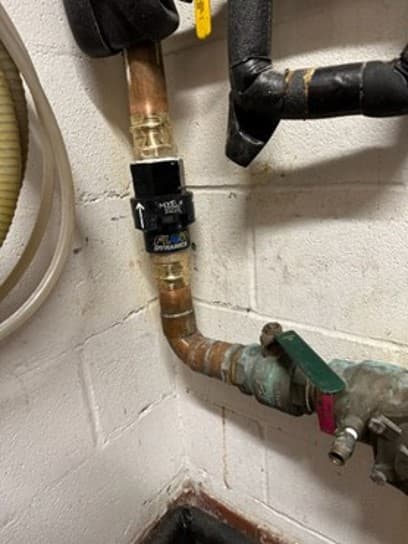
Smart Valve eliminates air from your water lines, reducing metered volume 20-35%. Every gallon you remove from your bill today saves even more when PFAS surcharges hit. Learn how →
Fix leaks before the rate multiplier increases their cost
A running toilet wasting 200 gal/day at today's rate costs $1,080/year. At tomorrow's PFAS-adjusted rate, it's $1,200-$1,300+. Leak detection pays for itself faster every year rates go up.
Lock in your conservation ROI before rates are recalculated
At current rates, Smart Valve typically pays back in 12-18 months. As PFAS-driven rates increase, payback accelerates — every conservation dollar saved is worth more. Calculate your savings →
Federal Funding: Will It Actually Help?
The Infrastructure Investment and Jobs Act (IIJA) designated billions for water infrastructure and emerging contaminant mitigation. Large legal settlements with PFAS manufacturers (3M settled for over $10 billion, DuPont for $1.2 billion) are also being distributed to affected water systems.
However, federal funding covers only a fraction of total compliance costs. The Clean Water State Revolving Fund (CWSRF) and Drinking Water State Revolving Fund (DWSRF) provide low-interest loans — not grants — meaning utilities still need to repay these costs. For most commercial ratepayers, higher water bills are coming regardless of federal subsidies.
Rates Are Going Up. Your Usage Doesn't Have To.
See how much you can save at your city's current rates — and how much more you'll save when PFAS surcharges arrive.