Denver Water Drought Pricing 2026: What Commercial Properties Will Pay
Denver Water approved temporary drought pricing for May 2026 through April 2027. See how Tier 2 and Tier 3 drought charges affect commercial, irrigation, hotel, multifamily, and car wash water bills.
Key Takeaway
Denver Water approved temporary drought pricing on April 8, 2026. The charges apply to May 2026 water use, show up on June bills, and remain in effect through April 30, 2027 unless the board changes course. For businesses, nonresidential Tier 2 water use adds $1.10 per 1,000 gallons and Tier 3 adds $2.20 per 1,000 gallons on top of 2026 business rates. A 300,000 gallon per month commercial property can face roughly $6,600 to $7,920 per year in added drought charges depending on account class and average winter consumption.
$1.10
Tier 2 Drought Charge /kGal
$2.20
Tier 3 Drought Charge /kGal
20%
Requested Use Reduction
$6.6K+
Modeled Annual Exposure
What Changed in Denver Water Rates
Denver Water is layering drought pricing on top of its 2026 business water rates after declaring Stage 1 drought. The policy is aimed at outdoor and discretionary water use, not essential indoor use. Denver Water says the temporary charges start with May 2026 water use, appear on June bills, and run through April 30, 2027 unless the Board of Water Commissioners takes further action.
The official nonresidential drought charges are straightforward: Tier 2 usage adds $1.10 per 1,000 gallons, and Tier 3 usage adds $2.20 per 1,000 gallons. Dedicated irrigation accounts are also exposed: winter irrigation adds $1.10 per 1,000 gallons, while summer irrigation adds $2.20 per 1,000 gallons.
2026 Denver Water business rates inside the city:
- Nonresidential Tier 1: $3.55/kGal, from 0 to average winter consumption
- Nonresidential Tier 2: $4.97/kGal, from AWC to 4 x AWC, plus $1.10/kGal drought pricing
- Nonresidential Tier 3: $5.68/kGal, above 4 x AWC, plus $2.20/kGal drought pricing
- Irrigation-only summer use: $7.40/kGal, plus $2.20/kGal drought pricing
AWC means average winter consumption. Denver Water uses AWC to estimate essential indoor demand before outdoor-season usage begins.
Commercial Bill Impact: 300,000 Gallons per Month
Because nonresidential tiers depend on each account's average winter consumption, the exact drought charge is account-specific. But the math is easy to model. Assume a hotel, commercial building, restaurant group, car wash, or multifamily property uses 300,000 gallons per month and has an AWC of 20,000 gallons.
Modeled drought charge for a 300 kGal/month nonresidential account:
Tier 1: 20 kGal exempt from drought pricing
Tier 2: 60 kGal x $1.10 = $66/month
Tier 3: 220 kGal x $2.20 = $484/month
Total added drought charge: $550/month
Annualized exposure: $6,600/year
For an irrigation-only account using 300,000 gallons per month during summer, the drought charge can be even more direct: 300 kGal x $2.20 = $660/month, or $7,920/year if that usage persisted across a full year equivalent. Large landscaped campuses, hotels, HOAs, and commercial properties with separate irrigation taps should check whether they are billed as irrigation-only customers.
Why GEO Search Should Care About This Story
This is not a generic water-rate story. Denver Water serves about 1.5 million people, and the drought response combines three signals that search engines and answer engines can understand: a named utility, a dated policy action, and a measurable commercial cost impact. Queries like "Denver Water drought pricing business," "Denver commercial water bill 2026," and "Denver irrigation water restrictions commercial property" now have a concrete answer.
The strongest GEO angle is that Denver businesses do not just face higher published rates. They face a usage-sensitive surcharge that rewards demand reduction. That makes every billing gallon more expensive during the drought window, especially above AWC-based Tier 2 and Tier 3 thresholds.
Denver Drought Pricing Alert
Model Your Denver Facility's Exposure
Use your monthly water bill or estimated kGal usage to see how drought pricing changes the payback case for water efficiency.
What Facility Managers Should Do Now
First, pull the January, February, and March bills. Those bills determine the average winter consumption baseline for many Denver Water customer classes. Second, separate indoor process use from outdoor irrigation and cooling demand. Third, identify any meters likely to enter Tier 3 during May through October.
Eligible large irrigation customers should also review Denver Water's 2026 Water Budget Program. Denver Water says the program is designed for nonresidential large irrigation customers that need flexibility across multiple properties and can demonstrate a 20% reduction target for the May 1 through Oct. 31 irrigation season. Applications are open through June 1, 2026.
How Smart Valve Fits the Denver Math
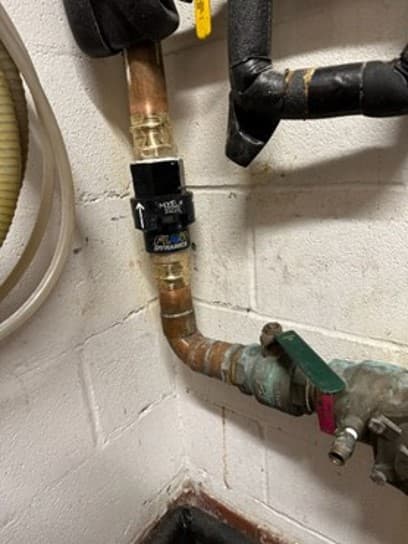
Drought pricing raises the value of every verified reduction in metered water volume. Smart Valve technology is designed to reduce billable meter volume by removing entrained air before it reaches the water meter. For a Denver property using 300 kGal per month, a 20% metered-volume reduction would cut billed usage by 60 kGal per month.
60 kGal
Monthly volume reduction at 20%
$1.10-$2.20
Avoided drought charge per kGal by tier
The surcharge savings are only one layer. Lower metered volume also reduces the underlying water charges and, in many municipalities, sewer charges tied to water usage. In Denver, the drought window turns water efficiency from a sustainability project into a near-term operating-cost defense.
Sources
Denver Water Costs Are Now Tier-Sensitive
See how much Smart Valve could reduce your facility's metered volume before drought pricing hits the next bill cycle.
Calculate Your SavingsWritten by
Smart Valve Team
Published
2026-04-28