Kansas City FY2027 Commercial Water and Sewer Rates: SAC Credits
Check KC Water FY2027 commercial water blocks, $12.90/CCF sewer, approved SAC credits and the difference between consumption aggregation and invoice consolidation.
Key Takeaway
KC Water’s FY2027 rate book applies to billings on and after May 1, 2026. General meter accounts pay a meter-size service charge plus ordinary water blocks of $6.38, $7.09, $6.06 and $4.20 per CCF. Inside-city sanitary sewer adds a $32.02 monthly service charge and $12.90 per CCF, subject to approved adjustments and other account-specific charges.
May 1
Effective Date
FY2027 rates
$12.90/CCF
Sewer Volume
Inside-city sanitary sewer
$49.30/mo
2-inch Water Meter
General service charge
$250
SAC Application
Car wash or laundry
How the FY2027 commercial water bill is built
KC Water’s FY2027 rate book applies to billings on and after May 1, 2026. The general meter rate combines a monthly service charge with an ordinary water commodity charge. The listed monthly service charge is $49.30 for a 2-inch meter and $316.50 for a 6-inch meter.
The ordinary water blocks are $6.38 per CCF for the first 6 CCF, $7.09 for the next 44 CCF, $6.06 for the next 9,950 CCF, and $4.20 above 10,000 CCF. The step down after the first 50 CCF means a flat blended rate will not reproduce the utility calculation.
A single invoice is not the same as combined consumption
For a campus with several service addresses, ask which accounts already share a rate-block calculation. KC Water’s Aggregate Consumption option combines eligible usage; Master Summary only consolidates invoices. A volume discount requires combined use above 50 CCF. Properties must share a block without a major road between them, have zero balances and working automatic readers, and exclude residential, fire-protection, stormwater-only and wastewater-only accounts.
As a 30-day illustration, suppose four eligible inside-city general accounts each use 40 CCF and are currently calculated separately. Their water commodity charges total 4 × [(6 × $6.38) + (34 × $7.09)] = $1,117.36. If KC Water approves aggregation, the same 160 CCF costs (6 × $6.38) + (44 × $7.09) + (110 × $6.06) = $1,016.84: a $100.52 difference with no reduction in water use.
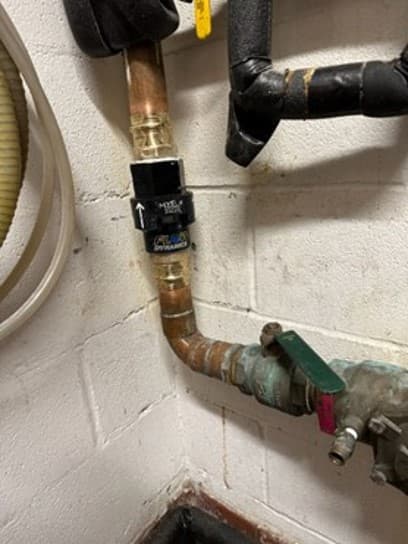
This excludes service charges, sewer, stormwater, taxes and fees. The tariff already combines meters serving one property; do not apply this example to use already aggregated. Confirm eligibility and the existing billing setup with KC Water. Account grouping is separate from a physical master meter and is not a Smart Valve result.
Model sanitary sewer separately
For accounts within Kansas City limits, the schedule lists a $32.02 monthly sanitary sewer service charge and $12.90 per CCF of volume based on total water purchased, subject to the rate book’s adjustments. Commercial and industrial accounts can also face wastewater-permit or high-concentration discharge charges.
Stormwater is a separate impervious-surface charge: $0.50 per month for each 500 square feet of runoff surface, with application-based ratio and detention credits. A change in metered water use does not by itself change the runoff-surface fee.
Directional 300-to-240 CCF example
Assume an inside-city account moves from 300 CCF to 240 CCF in one billing period. All 60 avoided CCF fall in the $6.06 water block, so the water-side exposure is $363.60. If billed sanitary sewer volume also falls by 60 CCF, the sewer-side exposure is $774.00.
Together, the directional usage-linked amount is $1,137.60 for that period. It is not a 20 percent whole-bill promise: water and sewer service charges, stormwater, discharge surcharges, taxes, minimums, and other account lines can remain. An approved diversion adjustment can also change the sewer calculation.
Car washes, laundries and other diverted-water uses
KC Water’s sewer allowance credit and sewer-metering rules cover uses where a significant share of purchased water is not returned to the sanitary sewer. The rate book names car washes, laundries, evaporation from cooling equipment, irrigation, water-to-product operations, other industrial consumption, and sewer metering.
The adjustment is not automatic. The account holder must apply before an adjustment, the department determines the diverted volume, and the adjustment takes effect only with the director’s approval signature. The listed application fee is $250 for car washes and laundries, $600 for evaporation or irrigation, and $1,250 for water-to-product, other, or sewer-metering applications. Discharge to the storm sewer is not allowed as a way to qualify.
What to check on the account
Confirm service address, inside- or outside-city status, meter size, billed CCF, existing account grouping, water block, sanitary sewer basis, any approved diversion adjustment, high-strength discharge lines, and the billed runoff-surface units.
Use the actual bill to reproduce each charge before estimating an operational or equipment change. A Smart Valve assessment should label the variable water and sewer exposure separately and test any result against comparable post-install billing periods.
Commercial Water Cost Alert
Model Your Facility's Exposure
Use your current monthly bill or kGal usage to estimate how much metered-volume reduction could offset this local rate pressure.
FAQ
When do Kansas City water and sewer rates change?
KC Water says new rates take effect at the beginning of the fiscal year, May 1. The FY2027 rate book applies to billings on and after May 1, 2026.
Why are Kansas City commercial sewer costs important?
The FY2027 rate book lists an inside-city sanitary sewer volume charge of $12.90 per CCF plus a $32.02 monthly service charge. Adjustments, discharge surcharges, and other account rules can change the final bill.
Can a Kansas City car wash or laundry receive a sewer-volume adjustment?
The FY2027 rate book includes car washes and laundries in its diverted-water adjustment program, but the adjustment requires an application, fee, site or plan review, department approval, and an account-specific diverted-volume determination.
Sources
Turn Rate Pressure Into a Water Savings Plan
Smart Valve helps commercial properties reduce metered volume before higher rates and surcharges multiply the cost of every gallon.
Calculate Your Savings