Commercial Laundry Water Costs: Usage per Pound, Utility Rates & How to Cut Bills 20-35%
Commercial laundry facilities use 1.5-3.5 gallons per pound of linen at $12.50/kGal national average. A mid-size facility processing 5,000 lbs/day faces $34,000-$80,000/year in water and sewer costs. Here's the math and how to cut it.
Key Takeaway
Commercial laundry facilities consume 1.5-3.5 gallons of water per pound of dry linen processed, making them among the most water-intensive commercial operations. At the 2026 national average combined rate of $12.50/kGal, a facility processing 5,000 lbs/day faces $34,000-$80,000/year in water and sewer costs. The "double billing" effect — where sewer charges mirror inflated meter readings — means a 20% meter overcharge from air in water lines costs laundry facilities $6,800-$16,000/year in phantom charges alone. Smart Valve technology eliminates this overcharge at the main meter, delivering verified 20-35% bill reductions.
1.5-3.5
Gal / Lb (Standard)
$12.50
Nat'l Avg /kGal
$57K
Avg Annual Cost
2×
Double-Bill Effect
How Much Water Does a Commercial Laundry Actually Use?
Water consumption in commercial laundry operations is measured in gallons per pound (gal/lb) of dry linen. The range is significant — equipment type alone can create a 3× difference in consumption:
Water Usage by Equipment Type:
- • Standard top-load washers: 3.0-3.5 gal/lb — Common in smaller laundromats and older facilities
- • Washer-extractors (front-load): 1.5-2.5 gal/lb — Standard in mid-size commercial operations
- • Tunnel/continuous-batch washers: 0.8-1.2 gal/lb — Industry-leading efficiency for high-volume facilities
For a mid-size facility processing 5,000 pounds per day with standard washer-extractors at 2.5 gal/lb, that's 12,500 gallons daily — 375,000 gallons per month. At the national average combined water and sewer rate of $12.50/kGal, that translates to $4,688/month or $56,250/year in water and sewer charges alone.
The Double-Billing Problem: Why Laundries Are Especially Vulnerable
Commercial laundry facilities face a unique cost amplifier: virtually 100% of incoming water is discharged as wastewater. Unlike a manufacturing plant that might consume water in product or evaporate it in cooling towers, laundries send nearly every gallon back through the sewer system.
This means every metering error — from air in water lines, pressure fluctuations, or meter drift — is charged twice: once on the water supply side and again on the sewer discharge side.
The Double-Charge Math (5,000 lb/day facility):
At 2.5 gal/lb with 20% air inflation: 375,000 gal/month metered → 75,000 gal/month is air.
Water overcharge: 75 kGal × $7.00/kGal = $525/month
Sewer overcharge: 75 kGal × $5.50/kGal = $413/month
Total phantom charges: $938/month = $11,250/year wasted
Regional Cost Variation: Know Your Market
Water costs vary dramatically by region. A laundry facility in Phoenix processing the same volume as one in Dallas may pay 40-60% more due to scarcity-driven tiered pricing and drought surcharges.
Annual Water/Sewer Cost by City (5,000 lb/day, 2.5 gal/lb):
- • San Francisco: $96,750/yr ($21.50/kGal combined)
- • Phoenix: $78,750/yr ($17.50/kGal combined)
- • Minneapolis: $61,500/yr ($13.67/kGal combined)
- • Cleveland: $57,375/yr ($12.75/kGal combined)
- • National Average: $56,250/yr ($12.50/kGal combined)
- • Dallas: $45,000/yr ($10.00/kGal combined)
Laundry Water Cost Alert
Is Your Laundry Facility Overpaying?
Enter your monthly water bill and facility size into our ROI Calculator to see your exact overcharge exposure and payback timeline.
3 Strategies to Cut Commercial Laundry Water Costs
1. Smart Valve at the Main Meter (Immediate Impact)
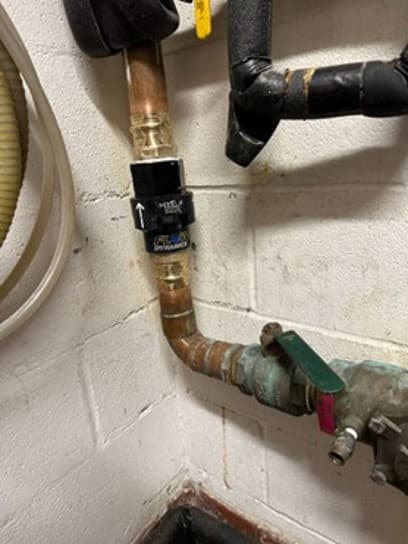
A Smart Valve installed on the customer side of the water meter eliminates entrained air before it reaches the meter register. Because laundry facilities are high-volume, continuous-flow operations, air entrainment is a persistent — and costly — issue. Smart Valve typically delivers 20-35% bill reduction for commercial laundry operations, with payback periods under 12 months at these consumption levels.
2. Equipment Upgrades: Tunnel Washers (Capital Investment)
Upgrading from standard washer-extractors (2.5 gal/lb) to tunnel washers (1.0 gal/lb) reduces water consumption by 60%. For our 5,000 lb/day example, that drops monthly usage from 375,000 gallons to 150,000 gallons — saving $33,750/year at national average rates. However, tunnel washers require $500,000-$1.5M in capital investment, making ROI timelines much longer.
3. Rinse Water Reclamation (Process Optimization)
Computer-controlled reclamation systems store final rinse water and reuse it as initial wash water for the next load. This technology reduces freshwater consumption by 25-30% without impacting wash quality. Combined with Smart Valve technology, facilities can achieve total bill reductions of 40-50%.
20-35%
Smart Valve Bill Reduction
<12 mo
Typical Payback
See What Your Laundry Facility Could Save
Enter your current water bill into our ROI Calculator for a personalized savings estimate based on your volume and local rates.
Calculate Your Savings →Written by
Smart Valve Team
Published
2026-04-11