How Much Water Does a Car Wash Use? Commercial Water Costs & Savings Guide (2026)
Commercial car washes use 8-85 gallons per vehicle depending on wash type. At $12.50/kGal national average, a tunnel wash running 200 cars/day faces $18,000-$47,000/year in water costs. Here's how to cut that by 20-35%.
Key Takeaway
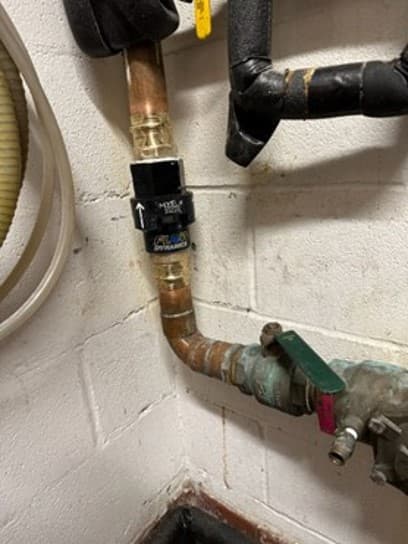
Commercial car washes use 8-85 gallons of water per vehicle depending on the wash system. Tunnel washes with reclamation are the most efficient at 8-15 gallons of fresh water per car — up to 90% less than home washing. For a busy car wash processing 200+ vehicles/day, water and sewer bills typically run $1,500-$6,000/month. A Smart Valve at the meter can reduce costs 15-25% by eliminating air from metered volume — saving $3,600-$18,000/year without changing any wash operations.
8-30
Gal/Car (Tunnel)
35-70
Gal/Car (In-Bay)
80-140
Gal/Car (Home)
75-90%
Reclaim Savings
Water Usage by Car Wash Type
Not all car washes are created equal when it comes to water consumption. The type of wash system you operate determines your baseline usage — and your savings potential:
| Wash Type | Gal/Vehicle | w/ Reclaim | Monthly (200 cars/day) |
|---|---|---|---|
| Self-Service Wand | ~15 gal | N/A | 90,000 gal |
| Conveyor / Tunnel | 30-85 gal | 8-15 gal | 48,000-510,000 gal |
| In-Bay Automatic (Friction) | 35-50 gal | 10-15 gal | 60,000-300,000 gal |
| In-Bay Automatic (Touchless) | 50-70 gal | 15-20 gal | 90,000-420,000 gal |
| Home (Garden Hose) | 80-140 gal | N/A | N/A |
What Does a Car Wash Pay for Water?
Water costs depend entirely on your local rates and daily volume. Here's what a tunnel car wash processing 200 vehicles/day at 30 gal/vehicle (180 kGal/month) would pay in different markets:
| City | Combined Rate | Monthly Bill | Annual Cost |
|---|---|---|---|
| National Average | $12.50/kGal | $2,250 | $27,000 |
| Gilbert, AZ | $14.00/kGal* | $2,520 | $30,240 |
| Cleveland, OH | $20.88/kGal | $3,758 | $45,100 |
| Baltimore, MD | $25.17/kGal | $4,531 | $54,367 |
*Gilbert post-25% rate hike (April 2026). Based on 180 kGal/month with no reclamation credit.
What's Your Car Wash Paying?
Enter your actual usage or current bill to see exact savings with verified 2026 rates for your city.
The Air-in-Lines Problem for Car Washes
Car washes face a unique version of the air-in-water-lines problem. High-pressure wash systems cause significant pressure fluctuations at the meter. When pressure drops during high-demand wash cycles, dissolved air in the supply line expands. The meter registers this expanded volume as water.
For car washes — which cycle between peak demand (active wash) and zero demand (between vehicles) dozens of times per hour — the pressure cycling creates more air expansion than in steady-flow facilities. This makes car washes particularly good candidates for Smart Valve technology.
Car Wash-Specific Savings Potential
- • Typical over-registration from air: 15-25% of metered volume
- • At 180 kGal/month at $12.50/kGal: $4,050-$6,750/year from air alone
- • At 180 kGal/month at $20.88/kGal (Cleveland): $6,773-$11,288/year wasted
- • Smart Valve payback for car washes: typically 6-12 months
4 Strategies to Cut Car Wash Water Costs
1. Smart Valve Installation (15-25% savings)
Eliminates air from metered volume. Works immediately — no changes to wash operations. Addresses the pressure cycling problem that's unique to car wash water meters. Learn how it works →
2. Water Reclamation Systems (75-90% fresh water reduction)
Reclamation systems filter, treat, and recycle wash water. A tunnel wash can reduce fresh water consumption from 30 gal/car to 8-10 gal/car. Capital cost is significant ($50K-$200K) but ROI is typically 2-4 years for high-volume operations.
3. Nozzle and Rinse Optimization
Upgrading to precision nozzles and optimizing rinse timing can reduce per-vehicle water use by 10-20%. Many operators find they're over-rinsing without affecting wash quality. A simple nozzle audit can identify 5-15 GPM in savings.
4. Leak Detection and Maintenance
High-pressure car wash systems are prone to leaks at fittings, valves, and hose connections. A 1/16" hole in a 60 PSI line wastes 25 gallons/hour — 18,000 gallons/month. Monthly pressure testing catches leaks before they become expensive.
Environmental Advantage: Commercial vs. Home Washing
Beyond water efficiency, commercial car washes offer a significant environmental advantage: they capture and treat wastewater. Home washing sends dirty water — containing oils, brake dust, detergents, and heavy metals — directly into storm drains and local waterways. Commercial facilities are required to treat wastewater before discharge or recycle it on-site.
This makes car washes both the economical and environmental choice — a rare alignment. A modern tunnel wash uses up to 90% less water per vehicle than a garden hose and keeps 100% of the wastewater out of local waterways.
How Much Can Your Car Wash Save?
Enter your current water bill or usage to see exact savings at your local 2026 rates.