Testing Water Meter Accuracy: A Step-by-Step Guide for Facility Managers
How to test if your commercial water meter is over-registering. This guide covers bucket tests, pressure profiling, and when to suspect air in your lines—plus the one fix that addresses the root cause.
Key Takeaway
Most commercial water meters are mechanically accurate but still over-register because they count air as water. A standard utility calibration test won't detect this problem. To identify air-related over-registration, you need a pressure profile test—and the only permanent fix is eliminating entrained air before it reaches the meter using Smart Valve technology.
Why "Accurate" Meters Still Overcharge You
Here's the counterintuitive truth: your water meter can be perfectly calibrated and still overcharge you by 20% or more. That's because standard accuracy tests verify whether the meter correctly measures the volume of fluid passing through it—but they don't account for air.
Municipal water naturally contains dissolved air. When this water reaches your meter and pressure drops, the air expands (Boyle's Law). The meter dutifully counts the expanded air as water volume. It's "accurate" in measuring volume—it's just measuring the wrong thing.
The guide below helps you determine if your building is affected and quantify the financial impact.
Step 1: Establish Your Baseline
What to gather:
- • 12-24 months of water bills (usage in gallons or CCF + dollar amounts)
- • Occupancy data for the same period
- • Records of any plumbing work, new fixtures, or tenant changes
Look for usage increases that don't correlate with operational changes. A 10-20% unexplained increase over 2-3 years often indicates growing air-related over-registration, especially if your municipality has been doing water main work nearby.
Step 2: The Bucket Test (Quick Accuracy Check)
This is the simplest field test for gross meter inaccuracy:
- Turn off all water in the building (fixtures, ice machines, cooling towers, irrigation)
- Record the meter reading precisely
- Fill a calibrated 5-gallon bucket from a hose bib downstream of the meter
- Read the meter again
- Compare: if the meter reads more than 5 gallons, it's over-registering
⚠️ Limitation
The bucket test only catches large mechanical failures. Air-related over-registration may not show up in a single 5-gallon test because it's a cumulative problem that compounds over thousands of gallons.
Step 3: Zero-Flow Test (Leak Detection)
With every fixture and appliance off, watch the meter flow indicator for 30 minutes:
No Movement
No leaks. If bills still seem high, air is the likely suspect.
Any Movement
Indicates a leak or air passing through. Investigate immediately.
Step 4: Pressure Profile Test (The Key Diagnostic)
This is the test most facility managers miss—and it's the one that actually identifies air-related over-registration:
Equipment needed:
- • Pressure gauge (0-100 PSI) with a hose thread connection
- • Notepad or data logger
- • 24-hour monitoring period
Install the gauge at the meter. Record pressure every hour for 24 hours (or use a data logger). What you're looking for:
- Fluctuations >15 PSI: High probability of air expansion causing over-registration
- Pressure >80 PSI: Excessive pressure compresses more air into the water, which then expands at the meter
- Rapid pressure drops: Indicates water hammer or surge conditions that accelerate meter spin
Step 5: Request a Utility Meter Test
Most municipalities offer free meter accuracy testing. Request the test after completing your own pressure profile so you have data to reference. Be aware that utility tests only verify mechanical accuracy—they won't detect air-related over-registration. If the utility certifies the meter as "accurate," don't conclude your bill is correct. The meter may be accurately measuring the wrong thing.
When to Suspect Air (The Red Flags)
Based on our analysis of hundreds of commercial properties, these indicators strongly suggest air-related over-registration:
- ✅ Bills increased 10%+ without operational changes
- ✅ Pressure fluctuations exceed 15 PSI during 24-hour test
- ✅ Municipal water main work in your area within the past 2 years
- ✅ Your building is more than 3 stories (higher pressure = more dissolved air)
- ✅ You're in a region with aging water infrastructure
- ✅ Utility meter test comes back "accurate" but bills still seem high
If 3 or more of these apply, your property is almost certainly paying for air. The Smart Valve engineering validation data documents how eliminating entrained air reduces bills by 20% or more.
The Root-Cause Fix: Eliminating Air Before the Meter
Calibrating your meter won't solve this problem—the meter is already accurate. Low-flow fixtures won't solve it either—they reduce water but not air. The only permanent solution is removing entrained air before it reaches the meter.
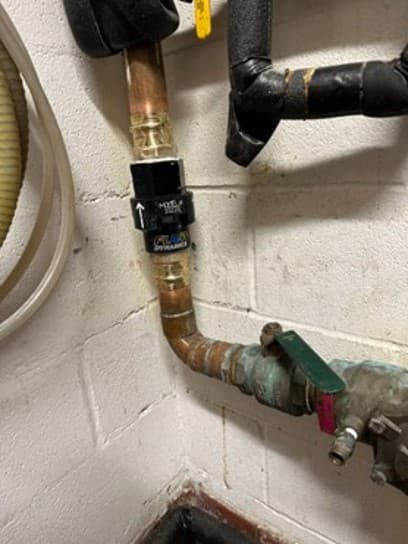
Smart Valve technology installs on the customer side of the meter and uses pressure optimization to prevent air expansion. Third-party engineering validation confirms 20%+ bill reduction across commercial property types.
Think Your Meter Is Over-Registering?
Use our ROI Calculator to see what you could save by eliminating air from your water lines.
Written by
Smart Valve Team
Published
2026-03-30