Seattle Commercial Utility Rates: 2026 Water, Sewer, and Drainage Charges to Separate
Separate Seattle commercial water seasonality, year-round actual-use sewer, approved submeters and property-based drainage. Includes the adopted 2027 water schedule.
Quick Answer
Seattle 2026 commercial water rates list inside-city peak usage at $7.70 per CCF and off-peak usage at $6.06, while sewer is $20.18 per CCF. Commercial drainage fees are parcel-based by hard-surface tier, so water savings and drainage exposure must be modeled separately.
$7.70
Peak Water
Inside Seattle per CCF
$6.06
Off-Peak Water
Inside Seattle per CCF
$20.18
Sewer
Per CCF in 2026
$44.35
2-Inch Base
Inside Seattle monthly
What changed in Seattle
Source-reported facts: Seattle Public Utilities lists 2026 commercial water base service charges and commodity charges effective January 1, 2026.
For inside-Seattle general-service water, the 2026 commodity charge is $6.06 per CCF off peak (September 16–May 15) and $7.70 per CCF during peak season (May 16–September 15). The 2026 sewer rate is $20.18 per CCF. Confirm the service area and prorated seasonal boundary on the bill.
Who may be affected
Hotels, restaurants, multifamily buildings, healthcare sites, office towers, campuses, industrial users, and high-irrigation properties should separate water seasonality, sewer volume, and drainage charges.
Commercial and industrial parcels also face drainage charges by parcel area and hard-surface percentage, which is a different cost driver than metered water use.
Why peak water, sewer, and drainage need separate models
Non-residential sewer uses actual water consumption throughout the year, subject to authorized adjustments, with a minimum of one CCF per premise per month. The residential summer winter-average rule does not apply to commercial accounts. A 2-inch inside-Seattle commercial water base is $44.35 per month in 2026.
Commercial drainage is billed annually through the King County property-tax statement under the SWM/Drainage line. Its calculation uses billable parcel area and the assigned hard-surface tier. It does not fall with metered potable-water volume.
What a 20 percent usage reduction could mean
Illustrative arithmetic, not a product result: assume an inside-Seattle general-service account uses 300 CCF in a 2026 peak month with no sewer deduction. A 20 percent reduction equals 60 CCF.
At $7.70 peak water plus $20.18 sewer per CCF, those 60 CCF represent $1,672.80 in monthly variable exposure. Base, fire service, drainage, taxes, credits and other adjustments are excluded. An existing sewer deduction changes the reducible volume.
Review cooling and irrigation sewer submeters before assuming a credit
SPU’s sewer submeter program can account for eligible water that does not enter the sanitary sewer, including irrigation or cooling-tower evaporation. SPU must authorize the configuration; deduct and chargeable meters serve different purposes, and cooling systems may require both.
Apply before installation, obtain the required review and inspection, and retain the accepted meter configuration and readings. The customer buys, installs, maintains and tests the submeters. Do not count an unapproved deduction or count an existing allowance again as new project savings.
Budget separately for the adopted January 2027 water schedule
Seattle Ordinance 127486, passed August 4 and signed August 6, 2026, adopts inside-Seattle general-service water rates effective January 1, 2027: $6.21 per CCF off peak, $7.89 at peak, and a $45.35 monthly base for a 2-inch meter.
Those are future water rates. The worked example above uses current 2026 rates throughout. Confirm the applicable 2027 sewer, drainage, fire-service and other charges before making a complete 2027 bill forecast.
What to check first on your bill
Confirm service area, peak or off-peak billing period, water CCF, sewer CCF, meter size, drainage parcel size, hard-surface percentage tier, and whether any drainage credits or low-impact discounts apply.
If the property has large parking, roof, loading, or paved yard areas, drainage can be a major non-usage exposure that needs a separate stormwater strategy.
Where Smart Valve fits
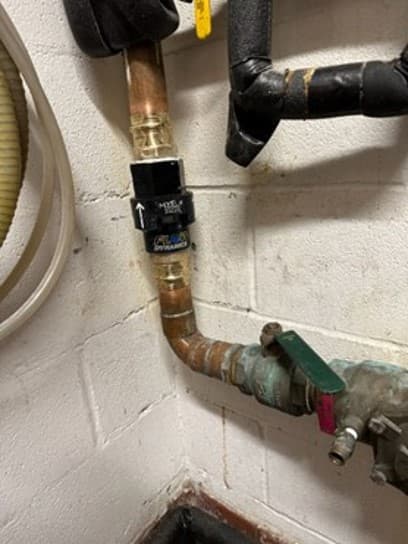
Smart Valve may fit Seattle properties where controllable water volume drives both water and sewer charges. It cannot reduce parcel-based drainage fees or meter-size base charges.
The strongest first step is to isolate peak-season water and sewer exposure from drainage and fixed charges before estimating payback.
What to Do Next
Separate peak water, off-peak water, sewer, and drainage before modeling savings.
Keep commercial drainage fees outside CCF-based usage-reduction estimates.
Check parcel hard-surface tier and eligibility for low-impact or stormwater credits.
Confirm SPU approval and existing readings before modeling a sewer-submeter deduction.
FAQ
What is Seattle inside-city commercial peak water rate for 2026?
Seattle lists inside-city commercial peak usage at $7.70 per CCF for 2026.
What is Seattle sewer rate for 2026?
Seattle Public Utilities lists the 2026 sewer rate at $20.18 per CCF. Non-residential accounts use actual water consumption year-round, subject to authorized adjustments; the residential winter-average rule does not apply.
Are Seattle commercial drainage fees based on water use?
No. Commercial drainage fees are based on parcel square footage and hard-surface percentage tier, not metered water usage.
Sources
- Seattle Public Utilities - commercial water rates (checked October 9, 2026)
- Seattle Public Utilities - sewer rates (checked October 9, 2026)
- Seattle Public Utilities - drainage rates and drainage-fee explanation (checked October 9, 2026)
- Seattle Public Utilities - sewer submeter program and application requirements (checked October 9, 2026)
- Seattle City Clerk - enacted Ordinance 127486, current 2026 and adopted 2027–2029 water schedules (checked October 9, 2026)
Related Commercial Water Resources
Model This Market Against Your Actual Bill
Use your local rate, current monthly bill, and billed usage to estimate how much controllable volume reduction could offset this market pressure.