Hayward Commercial Water and Sewer Rates: October 2026 Non-Residential Bill Checks
Hayward adopted non-residential water rates effective October 1, 2026 and sewer strength rates effective July 1, 2026. Commercial accounts should model water tiers, sewer class, irrigation meters, and critical-user charges.
Quick Answer
Hayward lists non-residential water rates of $9.22 per CCF for the first 110 CCF and $10.82 above 110 CCF effective October 1, 2026. Non-residential sewer rates effective July 1, 2026 vary by business type, from $8.91 per CCF for domestic use with irrigation separation to $28.81 for food manufacturing.
$9.22
Water Tier 1
First 110 CCF, Oct. 2026
$10.82
Water Tier 2
Over 110 CCF, Oct. 2026
$8.91
Domestic Sewer
With separate irrigation meter
$28.81
Food Mfg. Sewer
Per CCF, July 2026
What changed in Hayward
Source-reported facts: Hayward says City Council adopted water rates effective October 1, 2025 and October 1, 2026. For non-residential water, the October 2026 schedule lists $9.22 per CCF for 1-110 CCF and $10.82 per CCF above 110 CCF.
Hayward also lists adopted sewer rates effective July 1, 2026 through July 1, 2029. Non-residential sewer charges are calculated per CCF of metered water use based on the strength of discharged wastewater, with separate tables for accounts with and without separate irrigation meters.
Who may be affected
The commercial exposure is broad: restaurants, commercial laundries, food manufacturers, bakeries, beverage bottling, meat products, industrial laundries, fabricated metal users, multifamily assets, office buildings, healthcare facilities, and irrigated sites can land in different sewer categories.
For October 2026 water service, a 2-inch residential or non-residential bi-monthly fixed fee is $286.35, a 3-inch meter is $615.48, and a 4-inch meter is $1,100.52 before usage, fireline, sewer, or other charges.
Why sewer class matters more than the headline rate
Hayward sewer rates can vary dramatically by use. With a separate irrigation meter, July 2026 non-residential sewer rates include $8.91 per CCF for all other domestic use, $11.80 for restaurant with grease interceptor, $14.52 for restaurant without grease interceptor, $10.13 for commercial laundry, and $28.81 for food manufacturing.
Without a separate irrigation meter, the July 2026 schedule lists lower per-CCF factors for many categories, such as $8.02 for all other domestic use and $13.06 for restaurant without grease interceptor. That difference is a signal to review how irrigation and sewer billing are separated before modeling any usage-reduction project.
What a 20 percent usage reduction could mean
Directional estimate: assume a Hayward non-residential account uses 200 CCF per billing period and has separate irrigation, with sewer classified as all other domestic use. Water exposure is 110 CCF at $9.22 plus 90 CCF at $10.82; sewer exposure is 200 CCF at $8.91.
Reducing the account by 20 percent means 40 CCF less. At this usage level, the marginal combined water and sewer rate is about $19.73 per CCF, producing about $789.20 in variable exposure for that billing period before fixed service fees, fireline charges, critical-user charges, meter setup, site conditions, and installation feasibility.
What to check first on your bill
Confirm customer class, bi-monthly water CCF, meter size, fireline charges, sewer business classification, whether a separate irrigation meter exists, and whether the account is a coded user or a critical user.
Critical users require a different model. Hayward lists July 2026 critical-user components for flow, carbonaceous biochemical oxygen demand, and suspended solids, so a food, industrial, or manufacturing site should not use a standard domestic sewer model.
Where Smart Valve fits
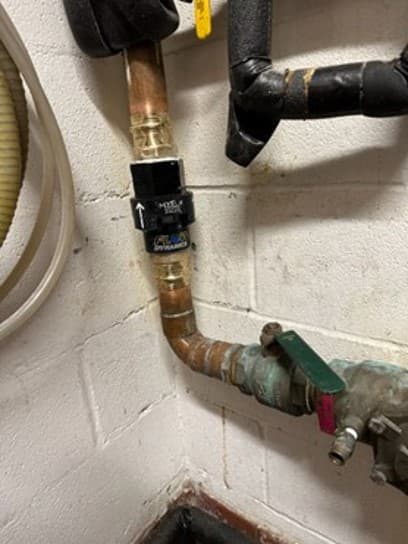
Smart Valve may be relevant when a Hayward commercial property has meaningful controllable metered water volume and the site is technically qualified. It cannot reduce fixed service fees, fireline fees, or wastewater strength charges that are driven by pounds of pollutants rather than metered water volume.
The correct assessment starts with the water tier, sewer classification, irrigation meter status, and whether sewer follows water consumption for the account.
What to Do Next
Identify sewer business classification before modeling savings.
Separate irrigation-metered water from domestic water and sewer exposure.
Flag critical users for flow, CBOD, and suspended-solids modeling.
FAQ
What are Hayward non-residential water rates for October 2026?
Hayward lists non-residential water at $9.22 per CCF for 1-110 CCF and $10.82 per CCF above 110 CCF effective October 1, 2026.
How does Hayward bill non-residential sewer?
Hayward says non-residential sewer is billed per CCF of metered water use based on discharged wastewater strength, with different rates by business category and irrigation-meter status.
Can usage reduction lower every Hayward commercial sewer line?
No. Usage reduction may affect water-linked sewer volume, but fixed fees, fireline fees, and critical-user pollutant charges may not decline with domestic water volume.
Sources
Related Commercial Water Resources
Model This Market Against Your Actual Bill
Use your local rate, current monthly bill, and billed usage to estimate how much controllable volume reduction could offset this market pressure.